Wednesday, 31 July 2013

Cult Currency

Perhaps one way to distinguish between how a 'cult' horror film and a 'mainstream' horror film is sold to their respective audiences is in the treatment of the content. While the mainstream horror is sold much like any film conforming to Classical Hollywood norms – a character-driven narrative, three-act structure, a logical chain of cause-and-effect – but including set-pieces designed to scare and repulse, the cult horror film is often sold by downplaying the actual content and instead emphasising the uniqueness of its premise. Indeed, the premise itself becomes so important to the cult horror film that in some cases we can see that it is conceived, financed, produced, marketed and consumed entirely on that basis, without actual content of the film playing any significant role. Cult horror films as they are sold (and indeed produced) today is not so much as entertainment, or even a commodity, but rather as a form of currency. The idea of a cult horror film passes from producer, to distributor, to film fan like a £5 note – its value is in the premise, not the characters, story, direction, or cinematography.

In the UK we can see three distributors that overtly take the cult-movie-as-currency approach; Shameless Screen Entertainment, Arrow Films (specifically the Arrow Video Collection) and 88 Films. Each of them uses the Cult Laboratories message boards as a means of advertising and gauging consumer interest (http://www.cult-labs.com/forums/). Fans communicate with the labels, suggesting possible titles for future releases and voting on cover artwork. Of course, these distributors also release films that are sold on a kind of 'cult prestige' based upon the content (Shameless release several Fulci and Argento films, Arrow have picked up several old Tartan Asia Extreme titles such as Battle Royale) but an overwhelming number of them are sold on their premises rather than reputation. One does not look at Ratman and assume that it is going to have high-quality direction and an intriguing plot. One instead looks at the tagline ('He's the critter from the shitter') and decides to watch it (or not) based upon its preposterousness. But because the majority of these films lack much merit beyond the bizarreness of their premises, strategies need to be employed in order to increase sales.


One major technique is to instigate a collector mentality in their buyers; all three distributors create a sense of unity within their catalogues – DVD covers are designed to not only convey the individual film's distinctness but also unify them under the 'Arrow' or 'Shameless' banner (88 Films already have a sense of unity in that their releases are all drawn from the output of Full Moon Features, the low-budget company behind the Puppet Master franchise, among others). Many of the DVD spines are numbered to increase the desire to complete the collection. Shameless releases can be recognised by the yellow and black colour scheme, while Arrow's 'colour bar' running at the bottom of the image distinguishes them from other cult film distributors. 88 Films has decided to utilise the current fascination with Grindhouse movies and released several titles under the 'Eighty Eight Films Grindhouse Collection' label, a way of trying to increase interest in films that otherwise have little appeal (The Day Time Ended, Seed People, Beach Babes From Beyond, and Mandroid have all been release under the Grindhouse banner despite their not being remotely 'Grindhouse' in any way).


Part of the art of selling cult horror lies in this form of presentation. Just as a film like Seed People isn't really going to sell unless it's placed within the Grindhouse Collection, certain products have to be arranged and organised in such a way to optimise their success. Arrow Video released several films produced by Fantastic Factory (a production label working out of Spain) but, perhaps foreseeing that few of the films would sell in and of themselves, Arrow Video collected the four films under the 'Fantastic Factory Presents...' banner, giving each a similar aesthetic on the DVD covers and providing extras that unify the films. Faust: Love Of The Damned includes the featurette Director Of The Damned: Brian Yuzna, Faust and The Fantastic Factory, which traces Yuzna's formation of the label and its first film, but the 'whole story' of Yuzna and Fantastic Factory is broken up over all four DVDs, with Romasanta: The Werewolf Hunt featuring the final documentary instalment Romasanta: Lycanthropes, Lunacy And The Last Days Of Fantastic Factory. If one wants to own Arrow Video's fairly encyclopaedic overview of the Fantastic Factory label and its influence on Spanish horror, one needs to buy all four releases.


U.S. distributor Anchor Bay utilised the exact opposite approach when releasing the television series Masters Of Horror. While Arrow took several films and used DVD extras to unite them into a single product, Anchor Bay took a single product and turned it into a label, a collection of 26 films. Just as with Shameless' covers, the Masters Of Horror releases each had their own unique look and self-styled logo, but were all headed with the same banner. Because the series is an anthology, with each episode directed by a famous horror director and all coming in at around an hour in length (rather than the standard 42 minutes of US television), Anchor Bay decided to give each episode its own release, packing the DVD with extras that emphasised the individual director and making of the specific instalment, thereby increasing sales thirteen times more than if they had simply released two 'complete season' box sets alone. It's interesting to note that in the interviews on the Fantastic Factory DVDs, Brian Yuzna claims that the idea for Masters Of Horror comes from his own idea for a series of films, each based upon one of the Seven Deadly Sins and directed by a famous horror director (several of the proposed directors for that series, such as Stuart Gordon and Dario Argento subsequently directed episodes of Masters Of Horror). When the idea fell through, he went to Spain to launch Fantastic Factory.


Creating the sense that these disparate films with bizarre premises can be seen as a single collection, something that needs to be completed by any self-respecting cult film fan, helps to draw attention away from the films' actual failings or achievements as films. The individual films simply become a checklist, a group of titles and premises. What's important is that one owns Surf Nazis Must Die, not that one watches it (and subsequently realises how poorly paced and dull the film is – as is the case with any Troma movie not directed by Lloyd Kaufman, it seems). The 'cult credentials' of the film are less about how weird the content or execution of the film is (as we might find with The Rocky Horror Picture Show or Eraserhead) and rather purely on the absurdity of the idea (surfing meets Nazis). The appeal of Shameless' Amsterdamned is almost entirely in its title and its premise of a serial killer in a wetsuit leaping out of the canal system. As a narrative, it's just another serial killer/hard-boiled cop movie making a desperate attempt to put a new spin on the tried and tested formula. In reality, few of the films released by these labels are really 'cult' but simply not very good genre films.


This way of presenting a less-than-impressive horror film as a 'cult' film by simply upping the ante in the absurdity of the premise is not limited to distribution but can also be found in production. Speaking of the Full Moon movie, Castle Freak (released in the UK by 88 Films – but too high a quality production to force into the 'Grindhouse Collection'), director Stuart Gordon recalls that studio founder Charles Band “had already sold the film on the basis of the title and the artwork alone. He said 'As long as you have a castle in this film, and there's a freak inside of the castle, you can direct it'” (from Anchor Bay's DVD release of Re-Animator). The process of 'pre-selling' a film is not new, nor limited to low-budget filmmaking. Plenty of big budget Hollywood films over the years have been 'pre-sold' on the basis of its star and premise, but in the low-budget arena pre-sales are an important part of being able to make films at all. As the inclusion of genuine stars is unlikely, a low-budget or independent film needs to have a clear and distinct premise in order to convince financial backers that it will be a success if made. You have to convince the money men that your Dutch crime film will do well because it is simultaneously a safe bet (serial killer movies are popular in the 1980s) and different from the others (the killer swims around the canals in a wetsuit).

Today, the trend of absurd movies, started by B-Movie master Roger Corman and continued by 'mockbuster' studio The Asylum, have tried to play the 'premise-is-everything' card as much as possible. Whether something relatively simple, such as Two-Headed Shark Attack, something a little more obscure, like Corman's Sharktopus, or the out-and-out ludicrous glory that is Sharknado, the situation is much the same: the film is conceived, sold, financed, produced, marketed and released on the basis of its initial idea. Sharknado the movie is not much different (a little inferior, in fact) to Sharknado the poster. As the tagline states: 'Enough Said!'


                                                                                                                                                       - P. S.

Thursday, 27 June 2013

Drawn People In Drawn Places

Walt Disney’s shift away from the dominant ‘cartoony’ style of 1930s animation into a more ‘realistic’ aesthetic was developed during the Silly Symphonies shorts and exemplified by the first two feature films Snow White And The Seven Dwarfs (David Hand et al.,  1937) and Pinocchio (Hamilton Luske et al., 1940) (Fantasia was also released in 1940 but it’s various segments were more experimental in their visual approach). This more realistic manner in animation was designed in several respects to replicate the real world around us (or, at least, the way in which the real world was presented in live-action films) and included a greater adherence to the laws of physics, and a closer resemblance to the proportion and arrangement of physical features that we find in everyday people and animals. But the greatest shift toward increased realism was in the rendering of the story worlds through the background art. I would argue that the artwork produced to create the surrounding environments became so detailed that it led to a disparity between the story world and the characters that were meant to inhabit it, because those characters were always required to maintain a degree of caricature in their design. When the studio shifted its feature film aesthetic to a more 'graphic' and stylised visual approach in the late 40s and 1950s, this was not simply the result of a decreased budget but was rather the fulfillment of many of the Disney artists’ and animators’ desire to reintegrate the animated characters back into their diegetic surroundings.

In 2011 some notes surfaced online that were available to read on the Cartoon Brew blog (http://www.cartoonbrew.com/classic/two-incredible-documents-nfb-animation-chart-and-t-hee-caricature-notes-40153.html). These notes were to a lecture given at the Disney studios on the nature of caricature by animator T. Hee (his real name, believe it or not). Hee was a sequence director at Disney during the 30s and 40s, directing the ‘Dance of the Hours’ sequence from Fantasia – featuring hippos in tutus, it is perhaps the most famous one after the ‘Sorcerer’s Apprentice’ sequence – as well as several sequences in Pinocchio. The purpose of the lecture was to encourage the animators to develop their 'caricatural' skills to the point where they would be able to take a look at a person, animal or object and then capture the 'essence' of that thing in a few quick lines. These newly honed skills would then impact upon their animation. Though the lecture notes are certainly interesting to read and offer an insight into the attitudes of staff at the Disney studio, it is the last third that is particularly pertinent to this discussion, as it turns its attention to the relationship between the caricatured character and the extremely detailed surroundings created in the background art.

But let us begin with a very brief history of animation: In the 1920s, animated cartoons were more or less a disposable medium much like newspapers. Indeed, many of these early cartoon characters originated in newspaper strips and – just as one reads a newspaper and throws it away once finished – cartoons existed as part of a reel, perhaps between the newsreel and the 'B' picture, or what have you. Once the cartoon was over you rarely saw it again. Disney was the first to try to elevate the form to something that could hold up to closer scrutiny and repeated viewings, and he and his crew developed several strategies in order to accommodate this. Chief among these was character comedy over gag comedy. The character were no longer simply a figure to whom comical events happened, but a definite personality which itself motivates the events of the story. There was also a greater adherence to the laws of physics. If Wile E. Coyote falls off of a cliff, we expect him to be able to get up and walk away afterwards, but in a Disney animation,  if a character such as Snow White falls off of a cliff, it creates genuine concern that they might not survive. Disney also wanted characters to have far more lifelike proportions and movements, and the for the worlds in which they lived to be rendered in increased details. It is this latter point that I want to focus on.


This first image is from the very first Felix the Cat cartoon Feline Follies (Otto Messmer, 1919). We can see that the art is a very straightforward depiction of a cat stood in a street. A collection of black and white lines come together to create an easy to understand representation with only as much detail as necessary to the moment.


In the next image from Disney's The Grasshopper And The Ants (Wilfred Jackson, 1934), we can see that the actual figure is still a fairly simple graphic image but it is now contrasted with considerably more detail in the rendering of the background. We can make out the veins on the leaves, we can see the play of light and shadows on the berry and dandelion and so on. There is now a slight disparity between the art style of the character and the art style of the surroundings. This trend of increasingly detailed background art continued into the first few features, Snow White and Pinocchio.


It is easy to see the increased detail in the Snow White image above. The sense of depth is created by what is known as the multiplane camera, which essentially functions like a perspective box, with each of the various layers of the image existing on a different plane, literally separated with a space between each successive component. The log and grass that makes up the bottom half of the image has not been painted to create that impression but is genuinely out of focus because of its relation to the camera and the rest of the imagery.


In this image we can see that Snow White as a figure is a realistically proportioned human being, she doesn't have a head the size of her torso or any other cartoon-like qualities. Likewise the animals, though slightly 'cutified', are more realistic than more anthropomorphic characters from the recent past (such as Felix or the Grasshopper). The sense of distance here is created by the play of light in the background, creating the sense of dispersion. The details such as the textures of the trees or the clouds in the distance are all rendered in this realistic style.

But we can also see that there isn't the same kind of detail on the characters as there is on the environment. We don't see the fur on the deer as we do the bark on the tree. The reason for this is fairly obvious; in order to make a character that is able to move, hundreds upon thousands of images of a character need to be produced. You cannot therefore afford (in terms of money or time) to manufacture them with the same degree of detail as you can in the single background image.


This 'hyperrealist' trend continues on into what I personally consider to be its pinnacle in Pinocchio. In the image above we can see, quite frankly, a preposterous amount of detail – we can see the grain in the wood, the cracks in the masonry, the spires and roofs going far off into the distance. We can make out individual tiles on roofs in the middle-distance (well, if the picture were bigger at least). There's even a surprising degree of less-than-wholesome detail, in the stains of bird-shit marking down the side of the belltower where the doves have been. There's no visual sugar-coating here – it is a fully realised fictional world.


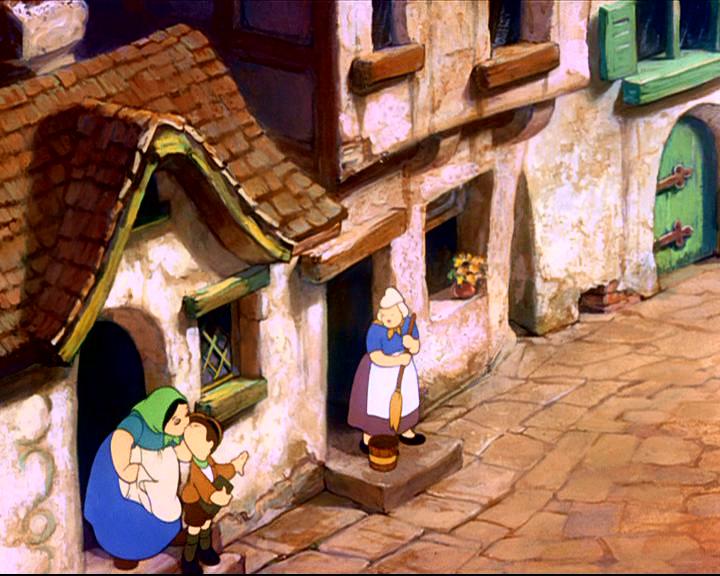
As we continue down we can see more details: there's laundry out on the line at the bottom left, with creases no less, the shadow of the chimney cast over the roof, or the bird's nest on the chimney. Every cobblestone has been meticulously rendered by hand. It is an unequivocally huge achievement in artistic detail – but the downside to this is that, by comparison, the characters begin to look pretty simplistic.


The figures in this image are just extras, no real effort has gone into their design, but we can see the increasing disparity between figures and environment in terms of detail, these characters don't seem to belong in these buildings. And this seems to be of some concern to T. Hee in his lecture. He didn't feel that the characters fit into their storyworlds anymore because of this aesthetic disparity. Perhaps as a result of this, we can see several techniques at work in Pinocchio that seem designed to try and bridge the gulf between character and background.

Pinocchio is obviously the story of a wooden boy that comes to life and wishes to become a real boy. The theme of animism, the idea of inanimate objects coming to life, lends itself very nicely to the animated medium. But more than this, the actual design of Gepetto's workshop where Pinocchio is born is designed to reflect the character's situation and to create a better 'fit' for the character.


This image is just one corner of Gepetto's workshop. He doesn't just make toys, he makes various mechanical objects, clocks, music boxes and so on. We can see the same kind of detail as the images from before, we can make out the grain of the wood, the play of light and shadows. It's the same level of detail but is designed to be far more 'cartoony' and broad. The images jump out at us a lot more. We can see a vibrant use of colours but also multiple little figures, creating a sense of densely packed activity. Although they're lifeless objects, they seem to convey a sense of dynamism.


This image is yet another corner of the workshop. Notice again the amount of small carven figures. Excluding Gepettto, Pinochio and Gepetto's pet cat and goldfish, there are no less than 309 faces in Gepettos workshop (yes – I counted them). Carved into clocks, toys, or in the furniture and beams, the entire environment is therefore imbued with life, reflecting Pinocchio's situation as an inanimate object brought to life thanks to the magic of both the Blue Fairy and the animated medium.


This moment from later in the film, where we have Lampwick in the process of changing into an ass, we have a different approach to easing the detail disparity. We can see the same kind of detail (shadows, textures, etc.), but the majority of the surrounding has been blacked out, the detail has been drained away in order to let us focus on the character. When Disney began to focus on characters and started making them more believable characters, this introduced something of a vicious circle. Because if you make the characters more believable, you have to make the world they live in more believable, but then the world becomes too believable and the characters no longer seem to fit anymore, and so attention needs to be drawn away from the detail in order to keep the focus on the character.


As Disney moved into the late 40s and 50s, the trend of realism died down and the approach to background art became quite different. In these (admittedly poor quality) images from Sleeping Beauty (Clyde Geronimi, 1959) we can see that there's clearly still detail, but the overall composition is a lot less geared toward realism, it has become a lot more angular drawing attention to its artifice in a way far closer to the Felix image than Pinocchio. There is a more of a simplified graphic aesthetic in both character and  backgrounds and so they seem to mesh a lot more. Classical animation history has it that the reason for this stylistic shift was essentially the Second World War; revenue from Europe was cut off and when America entered the war the military requisitioned the studio for the production of training films. When the war ended, the studio simply couldn't afford to put the same effort into the artwork of its films. However, I think that certain elements of Hee's lecture and the strategies at play in Pinocchio, demonstrate that there was in fact a desire within the studio animators to go toward this more graphic style. Although money was certainly one very real factor, I think that perhaps the more significant one was the desire of the artists themselves to make believable characters that existed in appropriately rendered worlds.


The above piece is a rewritten version of a paper presented at the Cradled in Caricature symposium at the University of Kent back in 2011. If you so wish, you can listen to me deliver it over on the official site (http://cradledincaricature.com/events/cic-symposium-20-june-2011/) – bearing in mind that my notes consisted entirely of about 6 bullet points, so there’s an awful lot of the word ‘um…’ in it.

Thursday, 3 May 2012

Madness For Mass Consumption


Madness For Mass Consumption: Werner Herzog And The Fictional Real


Werner Herzog’s cinema is well known for blurring classifications of fiction and non-fiction, of traditional narrative cinema and documentary. As such it is often difficult to distinguish, or even trust, what one is seeing up on screen. Part of the ambiguity is rooted in our own need for dichotomies, the idea that we can categorically define fiction from non-fiction, even if it is only on a film by film basis. Dirk Eitzen argues documentary as a mode of reception[1], whereby a spectator might distinguish between the fiction and non-fiction by asking if the film might be ‘lying’; fiction is, after all, not a lie and so the question only becomes pertinent to non-fiction cinema. We do not ask if Die Hard is lying, but we might raise such concerns over the work of Michael Moore. This ‘either/or’ approach leads to our categorising films as one or the other – never both at the same time. Of course, linguistically, it does not make sense to say that something can be fiction and non-fiction simultaneously, and yet with the films of Herzog we often find these two forces at work, in a constant state of flux. While Eitzen might maintain that an individual film can shift from one to another from moment to moment, Herzog’s films shift in shades of grey, never really being either at any given time.

Vivian Sobchack argues that every so often, a certain element or idea contained within a fiction film will engage our ‘documentary consciousness’[2], that is to say, a momentary break from the traditional patterns of suspension of disbelief caused by some comment, event or image that makes us aware of the reality behind the film. She cites the particular example of the image of a rabbit being shot in the hunting sequence from The Rules Of The Game (Jean Renoir, 1939) and how the comfortable position of being a viewer of fiction is shaken by our awareness that the rabbit has really been shot, that it will not be getting up again after the director has shouted ‘cut’. Here we can see a similar, though not identical, idea to Eitzen; certain moments during a fiction film can shift to non-fiction because a different level of perception has been engaged. But rather than Eitzen’s choice to read the film as ‘either/or’, Sobchack claims that these moments bring attention to elements which are constantly at play in live-action cinema but which we often take for granted. It is not a choice for the viewer; Renoir’s rabbit shocks us into this realisation. Thus, while both acknowledge elements of fiction and non-fiction are nestled in a film text, waiting to be acknowledged or revealed at different points during a film’s runtime, Eitzen views the process as a kind of magic-eye trick, we see Wittgenstein’s rabbit or duck, not both at the same time; but Sobchack views the process as a rude awakening, a violent shake from our viewing patterns.


These elements described by Eitzen and Sobchack only begin to graze the surface of how these intersecting elements of fiction and fact are utilised by the films of Herzog, often intentionally engaging our ‘documentary consciousness’ in fictions and asking us to suspend our disbelief in apparent documentaries. It is a defining aspect of Herzog’s cinema that it has never concretely committed to either bracket of fiction or non-fiction. It is as if – understanding the central nature of the film camera (that it records objectively whatever is put in front of it) – Herzog realises that even the most meticulously rehearsed fiction is still a factual record of that performance event. But on top of this, Herzog is undeniably a fantasist, rearranging the world to suit his perception of it, recounting stories and anecdotes with such veracity that it scarcely matters that they never actually happened[3]. It is this dual nature of Herzog the visionary, who has perhaps never really seen the real world, and his understanding of the relationship between reality and its photographic record that has resulted in a career that incorporates the objective truth with the fantastic of the delusional.

His films invite us to activate our ‘documentary consciousness’, to try and piece together what we see in front of us both in terms of its fictive meaning and its factual content simultaneously. To say that Herzog’s films blur the boundaries between fact and fiction is to oversimplify and miss the complexities of overlapping layers between the apparent world of the film and the so-called real world that surrounds it. We can find this complexity in several Herzog films, not least of all Heart Of Glass (1976), a film which might be termed fiction but that undoubtedly speaks to our awareness of the circumstances existing outside of – and sometimes in – the frame.

The film employs a ‘gimmick’ that is separate from the fictional narrative but adds to the effect of the film and its theme. The story is one of mass hysteria and obsessive madness that grips a small isolated village when the secret of how to produce Ruby Glass is lost due to the death of the head glass-blower, who took the secret to his grave. This eerie sense of mass hysteria, of people no longer thinking entirely as individuals, is conveyed in the performances of the actors, most of whom performed under hypnosis. This factor is not a narrative conceit, it is not the story of characters being hypnotised. Hypnosis is employed to create the effect of a dream-like state, a distracted kind of illogical thinking that the characters are in the grip of.

This difference – the actors are in a condition that the characters are not – heightens our awareness of the film’s relationship to the real. On one level, it is quite possible to read the film as a documentary about people under hypnosis, the narrative simply existing as a framing device. When, for instance, one character smashes a glass on the head of another character, he does not wince on the impact so deeply in trance is he. We not only take in the narrative significance of the scene – the characters being hostile toward one another – but are also impressed with the response of the human body under hypnosis. The ‘documentary consciousness’ is elicited through much of the film but within the context of fiction, not as a shock moment that shifts our perception to another level.

Thus, with Herzog’s cinema the distinctions between fiction and non-fiction break down, as quite often the imagery that we see is carefully designed to be both at the same time. It is precisely this ambiguity, this impossibility to define which image is fact or which event fiction, that has led to the most common criticism levelled against him – the ethics behind the production and presentation of his images[4]. How much of his ‘fact’ is created, how much of his ‘fiction’ a record of reality? These questions are particularly pertinent when looking at the tempestuous relationship between Herzog and his friend/opponent Klaus Kinski, who starred in five of Herzog’s feature films and was the subject of one of his documentaries. Like the native workers in Fitzcarraldo (1982), one might view Kinski as equally the subject of Herzog’s documentary gaze.

The relationship between Herzog and Kinski is well documented as being an intense and largely irrational one where the two butted heads over nearly everything – not least of all because both men were equally as single-minded, obsessive and self-absorbed – and yet apparently remained strong friends up until their final film together. Kinski was known for being impossible to work with, his bursts of rage at the slightest provocation made shooting scenes with him highly difficult. Likewise, Herzog is still associated with an Ahab-like desire to shoot a film in exactly the way he has decided, irrelevant of how uncomfortable or even dangerous this makes life for his cast and crew. Putting two such volatile figures in close proximity would inevitably lead to emotional explosions.

Made eight years after the death of Kinski, Herzog’s My Best Fiend (1999) claims to show us the nature of this relationship as objective fact, though it is very clear from the start that Herzog has a very specific agenda in mind, even if it subconscious. Opening with footage of Kinski raving at an audience during one of his ‘Jesus Tours’ (though the film never informs us of this), this image of Kinski – as a raving madman, ranting at the masses before him – is presented entirely without context. Though the footage itself is objective, it was shot by someone other than Herzog, capturing a genuine spur of the moment response from Kinski (though how genuine the response is could be debated), the presentation of the footage by Herzog demonises Kinski from the very beginning. Indeed, Herzog often portrays “Kinski as the culprit rather than the subject of the documentary”[5] through this kind of presentation, throwing a certain kind of light on Kinski that obscures some parts of his character.

This opening is then juxtaposed by the very sedate Herzog himself who politely makes his way through the flat where Herzog lived as a child, in the same building as Kinski, now owned by a well-to-do German couple. Herzog’s intention is quite clear, to accuse Kinski of irrationality and himself of level-headedness. He proceeds to tour the flat, pointing out where he and his family used to live and the various places where Kinski threw his many fits. Though he speaks to the old couple, it is clear that they are merely an excuse; Herzog is relating these facts to us.

The opening establishes the two complexities that lie in both the film text and the relationship between the two men. Firstly, Herzog is very conscious of Kinski’s mental instability. His childhood memories make it quite clear that he was well aware of what Kinski was like at home, never mind when under the pressures of trying to shoot a film in the Amazon. And yet Herzog still consciously placed Kinski in situations where he knew he would get angry. Secondly, as was touched on a moment ago, Kinski’s ravings during the Jesus Tours might not be as authentic as they first appear. As Herzog mentions later in the film, many of the audiences for the Jesus Tour simply wanted to watch him rave. We might wonder whether Kinski consciously placed himself in these situations, setting himself up to be infuriated because he knew that it would go down well.

And so we must ask, how much of the relationship between these two men was the result of their own conscious attempts to elicit particular responses from one another? And on top of this, how much of Herzog’s version of Kinski is a creation of the film, a fiction being documented? Here the ethics of presentation are highlighted. Is My Best Fiend really an accurate documentary or a fictional account of a real person, presented as fact? Here, perhaps, is where Eitzen’s ideas would appear to be most suited to Herzog’s cinema. Because of its claims to objectivity – claims rare in Herzog – we are forced to ask “might the film be lying?”.

Herzog constantly makes claims that are never corroborated. He tells a story of how one of the men working cutting down trees while filming Fitzcarraldo cut off his own leg after being bitten by a snake. Herzog says that he had to make sure that Kinski didn’t find out because he would begin raving once it became clear that he was no longer the centre of attention. At no point are we meant to question this claim or what it tells us about Kinski, even though it is entirely supposition on Herzog’s part. When interviewing Eva Mattes, he prefigures the interview – which shows Kinski in a distinctly positive light – with the statement “she was one of the few women with anything good to say about Kinski”. And yet we are never shown one of the apparent multitude of women with something bad to say about him. We are simply told to believe that this is the case; Herzog’s word is proof enough.

Another important consideration to take into account in terms of Kinski’s role in Herzog’s films is the responsibility of Herzog in eliciting so much of Kinski’s rage. One of the extras from Aguirre, Wrath Of God (1972) recounts the story of how Kinski hit him over the head with the hilt of his sword, cutting him in the process. Had he not been wearing his helmet, he tells Herzog, he would probably have died. And yet this story is presented without the slightest hint of blame towards Herzog, who had brought Kinski out to the jungle to be in the film, fully aware – as his childhood memories testify – of what he was capable of. This point, that Herzog is the one who has placed Kinski in such extreme conditions in order to get the reactions that he requires for his vision, is key to understanding both Aguirre and Fitzcarraldo. Though Kinski was undoubtedly a terror to work with, nearly all of the extreme stories of his behaviour in My Best Fiend are taken from the filming of these two works. Both of which were shot in circumstances difficult enough to push a well-balanced individual over the edge, never mind one as volatile as Klaus Kinski.

Les Blank’s Burden Of Dreams (1982), a revealing documentary on the making of Fitzcarraldo, shows Herzog as an uncompromising man obsessed with the achievement of his artistic vision – a vision which can only become realised once he and his crew have hauled a real steamer ship over a mountain. Everything is secondary to his vision; at one stage the engineer in charge of safety quits because he is convinced that the pulley system will break and kill a great many people. In a scene before he leaves, we see him and Herzog discussing the pulley system and the potential fatalities. Herzog very casually asks “If there were sixty people, how many could die?”. Unfair though it might be it is difficult not to read this moment as Herzog weighing up acceptable losses.

The fact that Herzog in no small way mirrors his lead characters in their obsessive single-mindedness is significant to understanding his approach to fiction. Often the lead characters – flawed though they certainly are – are presented as tragic antiheroes; the pursuit of the dream, even if that dream is never realised, is viewed as a noble cause, worth the sacrifices made by the characters. As such, it seems, Blank’s documentary wants to mirror the fictions of Herzog, focusing on the misery and obsession, the insane attempt to go up against the odds and nature. When Herzog finally does get the boat over the mountain, this is mentioned as an afterthought in the documentary’s last few minutes. Although in reality the feat was a success, Blank’s film is interested concerned with the more dramatic near-failure.

It is not only Herzog who mirrors the lead characters of these films; Kinski too is a persona closely bound to the fictional Aguirre and Fitzcarraldo – not least of all because we can never be entirely sure which entity – fictive character or factual Kinski – we are watching at any given time. His characters were driven to insanity and desperation through the extremity of their surroundings, just as he is driven toward a similar state through the process of filmmaking.

Both of the ‘jungle films’ can be seen in this context. Kinski’s responses to the surrounding environment were – though certainly extreme – nonetheless understandable. As My Best Fiend demonstrates, Kinski was in fact far better behaved when filming in European civilisation, the circumstances of being isolated in the Amazonian jungle might well be largely responsible for his oft cited erratic behaviour. And we might well blame Herzog for placing Kinski and his fellow cast members in these circumstances. As the narration from Burden Of Dreams informs us: “Herzog claims that the isolated location will bring out special qualities in the actors and even the film crew” – with Herzog happily admitting that the isolated filming is not a necessity for the narrative but instead designed to elicit the right effect, we can see how the production circumstances of both Fitzcarraldo and Aguirre were much the same as with Heart Of Glass.

Fitzcarraldo in particular is famed as an example of how the production circumstances mirrored the content of the film, how the “production difficulties somehow became the real event of which the film when it finally appeared seemed in a sense to merely record”[6]. Determined to do in reality what Fitzcarraldo does in the fiction, Herzog was not content to simply construct a series of special effects to demonstrate the fiction – he was determined to simply do it and, documentary like, record it actually happening. There are no ‘special effects’ as we watch the natives at work on the pulley system that really moves the steamer uphill (though there is some traditional smoke-and-mirrors; a bulldozer is pulling much of the weight). When it breaks in the story, it is because it actually broke in reality. In fact, so blurred is the line between fact and fiction with Herzog that a shot of a native apparently crushed to death under the boat was thought to be real, even though we can see him get up and wash the mud and blood from his clothes in Blank’s documentary.

One might easily read Fitzcarraldo as a documentary framed (and justified) by fiction. The moving of the boat over the hill, the pulley mechanism built to achieve this, the section of jungle cut away to nothing in order to build the system; all of this occurred in reality and is recorded as such, with occasional fictional inserts of Fitzcarraldo and his crew. But the only reason that Herzog wanted to move the steamer over the mountain in the first place was because it occurred in the fiction. It is a fictional presentation of a documentary record of a fictional event. Even the documentary elements are intertwined with the fictional so as to defy any sort of clear distinction.

Like the multilayered presentation of Kinski as man/monster/character/actor/objective truth/imagined fantasy, Herzog’s films are mercurial by definition. No system of classification or ontological debate can fully encapsulate the odd world-view captured and expressed in his films. His cinema is neither fact nor fiction, simply film – any attempt to try and pigeonhole them further would be an effort too much even for Herzog’s characters to attempt.


Bibilography

Bachman, G. – ‘The Man On The Volcano: A Portrait Of Werner Herzog’ in Film Quarterly (Vol. 31, No. 1, 1977)
Basoli, A. G. – ‘The Wrath Of Klaus Kinski: An Interview With Werner Herzog’ in Cineaste (Vol. 24, No. 4, 1999)
Corrigan, Timothy – ‘Producing Herzog: From A Body Of Images’ pp. 3-19 in The Films Of Werner Herzog: Between Mirage And History (Edited by Timothy Corrigan), Routledge, 1987
Eitzen, Dirk – ‘When Is A Documentary?: Documentary As A Mode Of Reception’ in Cinema Journal (Vol. 35, No. 1, 1995)
Elsaesser, Thomas – ‘An Anthropologist’s Eye: Where The Green Ants Dream’ pp. 133-156 in The Films Of Werner Herzog: Between Mirage And History (Edited by Timothy Corrigan), Routledge, 1987
Sobchack, Vivian – Carnal Thoughts: Embodiment And Moving Image Culture, University Of California Press, 2004


[1] Eitzen, 1995
[2] Sobchack, 2004
[3] Bachman, 1977, p. 3
[4] Corrigan, 1986, p. 12
[5] Basoli, 1999, p. 32
[6] Elsaesser, 1986, p. 135

- P. S.

Tuesday, 31 January 2012

In Memoriam

Today, to mark what would have been Derek Jarman's 70th birthday, I would like to post an amended conference paper I recently presented at the University of Kent's 'The End Of...?' conference, titled 'Political and personal apocalypse in the films of Derek Jarman'. I'd love to have more images and clips, but Blogger is telling me the entry is too large!
Derek Jarman is a filmmaker whose work I return to again and again with enternal joy and enthusiasm. Without him, it is highly unlikely I would be carving a future in academia: my undergraduate final paper and my MA thesis were on his Caravaggio (1986), and my PhD thesis is inspired by his relationship and work with Tilda Swinton. Thank you for your inspiration, and happy birthday!

Pete Tainsh - Derek Jarman at the Edinburgh Filmhouse 18/08/91

* * * * *

To begin, there’s a quote in the prologue to Dancing Ledge, one of Derek Jarman’s later published diaries, that neatly summarises the focus of this paper:


‘On December 1986, finding I was body positive, I set myself a target: I would disclose my secret and survive Margaret Thatcher’. (Jarman, 1991: 7)


Here, Jarman alludes to the two political threads that permeate his films; his negative opinion of the Thatcher-led Conservative party, and his role within the gay-rights movement, which post-diagnosis became more dominantly AIDS activism based. These two positions go hand-in-hand, with Thatcher’s passing of the now infamous Section 28 in 1988, a bill prohibiting the ‘promotion’ of homosexuality, providing the clearest political example of the homophobia that was rife in England at that time. Jarman died in 1994, but outlived Thatcher in terms of political tenure at least: her Prime-Ministerial reign ended in 1990, but Jarman continued to act in a self-appointed position as one of the few outspoken figures of the illness, with his work, as an artist and a filmmaker, becoming an increasing convergence of political and personal concerns; HIV/AIDS awareness necessarily overlapping the two fields.

So then, what about the apocalypse in Jarman’s films? Robin Wood suggests that the metaphysical visualisation of the apocalypse seen as, for example, the end of the world, can often be interpreted within social and political terms. Here, in his brief assessment of the ‘apocalyptic’ in American horror films, these terms are ‘the end of the highly specific world of patriarchal capitalism’ (1984: 192). In Peter Hutchings’ recent exploration of the broad notion of the apocalypse in British cinema of the 70s, it is seen as a cultural and commercial remark of the ‘shared conviction that the current social order is fragile and susceptible to collapse’ (2010: 116). In Jarman’s films, as I shall discuss, the suggested social/political position is clear: the visual imaginings of destitute, apocalyptic England are an unambiguous critique of the Thatcher years, voicing a dominant political statement that runs through much of his work. I’m interested in the apocalyptic images and tone of Jarman’s films, specifically Jubilee (1977) and The Last of England (1987), their expression of political, and then progressively dominant personal concerns, and the culmination of this in the non-representational image and aural narrative of his final film, Blue (1993).

This notion of the ‘apocalypse’ presents itself in various forms in the films. Jubilee imagines its end of the world in a prediction: Elizabeth I calls for the angels to entertain her, and is presented with the social devastation of an anarchic post-monarchic future, coloured by the Punk movement of the 70s. There is little sense of an authoritarian power; the Queen is dead, and even the police seem driven by personal impulse rather than constitutional obligation. The characters go around torturing, maiming, and killing. The state, or what is left of it, is effectively owned by one man: Borgia Ginz, a Rupert Murdoch/Richard Branson media-mogul type figure, who turns Buckingham Palace into a recording studio, and exclaims, through maniacal laughter: “As long as the music’s loud enough we won’t hear the world falling apart”.

The Last of England, in its episodic use of mixed footage, similarly presents the deterioration of the country, in part, through the lack of traditional authority figures. The loosely-structured narrative establishes the Docklands area we are introduced to as controlled by a group of balaclava-wearing men, with additional characters seemingly enslaved by social deprivation and insurgent rule. The images of environmental neglect seen in Jubilee reappear, with desolate, damaged surroundings and derelict buildings, fires, and general urban decay.

Just as Jubilee compares the imperial sovereignty of Elizabeth I to the social decline of the Second’s reign, The Last of England presents the terrorist state in contrast with the footage of the pleasant wartime childhood of Jarman. In both films, the idyll of the garden past is juxtaposed with the derelict urban wasteland of the present – that is the 80s present of the film - recalling Andrew Higson’s view of the Edwardian manor-house and gardens in the Merchant-Ivory type ‘heritage’ films of the 1980s as mournful pastoralism.

Jarman openly criticised the nostalgic cinema that ruled the British film industry during this period as a Thatcherist parable representing middle-class entitlement, and avoids the trap of the heritage film, as Higson suggests, of the ‘visually spectacular pastiche [which invites] a nostalgic gaze that resists the ironies and social critiques so often suggested narratively’ (2006 [1993]: 91) of these films, by questioning this sense of the historical, striving for a more imaginative treatment of history, and commenting on the role of the past in the construction of the present. So, Jubilee may present an image of the Elizabethan past as a refined haven critical of the anarchic present – a point, perhaps in part, related to the character of the Queen’s alchemist John Dee, a historical figure much admired by Jarman - but the film concludes in the present world with Bod’s gang residing, along with Hitler, in a country manor, that visual staple of ‘heritage’ excess, owned by Borgia Ginz: a figure of the corporate greed encouraged by Thatcher’s government and despised by Jarman.

Beyond images of the garden, the representation of the past in The Last of England, as seen in the Super 8 home-videos by Jarman’s father, is problematic. In one notable montage is it difficult to discern between footage shot by Jarman, footage shot by his father, and archive documentary footage. Thus, the images of burning buildings align the damage caused during the wartime Blitz with the social riots of the 80s, in places such as Brixton, alongside the fictional destruction presented in the terrorist ‘narrative’. Likewise, it is unclear if the gunmen in this sequence are the actors seen earlier in the film, or authentic IRA gunmen from documentary footage.

The wartime footage from Pakistan from this sequence, shot by Jarman’s father, recalls another fitting observation from Andrew Higson: that heritage films set in colonial countries, like David Lean’s Passage to India (1984), document ‘the process of decay, the fall from [an] utopian national ideal: in most cases they chronicle the corrupt and decadent last days of imperialist power’ (2006 [1993]: 104). This sequence, which builds to an editorial frenzy with the musical climax of Elgar’s Land of Hope & Glory, explicitly expresses this, juxtaposing the sense of national pride, associated with the past – demonstrated by the use of the deeply patriotic theme, images of colourful military marches, and national statues – with images of contemporary conflict and degeneration: again, burning buildings, and threatening gunmen. There is often a slow cross-fade between two images, one of the past and one of present, which unambiguously encourages us to consider our own relationship with, or perception of the historical. This culminates with the musical composition drowned out by war sirens, and the frenetic images of empty, abandoned warehouses edited alongside a shot of a floating poppy wreath. This ironic arrangement establishes a clear anti-Thatcher sentiment, connoting the active Falklands conflict, Jarman’s disapproval of the war, and commenting on the perversion of our country’s wartime patriotism and pride in the face of death and destruction.

To return, briefly, to the consideration of the garden in these films, it is worth briefly noting Jarman’s former home in Dungeness in Kent. Prospect Cottage sits on the shingle beach headland, in this strange, desolate environment. Jarman used local plants and gathered flints, shells, and driftwood for sculptures to decorate his garden. There is something apocalyptic about the area and the looming presence of the nuclear power station that dominates the skyline. Jarman became as famous for this garden as he did for his films, with it becoming a distinguished part of his artistic career, and providing the location for his 1990 film The Garden. Significantly, he kept a diary documenting the progress of the garden, which was later published as Modern Nature.

Jarman kept diaries for the production of all of his works, providing, as Jim Ellis summarises, a ‘generically impure blend of personal, familiar, and social history, along with aesthetic and political observations’ (2009: xii-xiv). Elements of this can, of course, be seen in the quote I began this talk with, but this is further exemplified by his autobiographical approach to filmmaking, offering his life and opinions for observation. This sense of the personal is marked explicitly with Jarman’s presence in his films. He has a tiny cameo in Jubilee at The Kid’s – a young Adam Ant - performance for Borgia Ginz. In The Last of England this presence is more instructively manifest from the opening sequence, with Jarman writing at a desk surrounded by books and writing implements, inscribing his thoughts on the pages of his diaries. He reappears at later intervals as, for example, a shadow in the frame, and a young boy in his father’s films. This is further extended in Blue when Jarman’s familiar voice emerges unannounced, from a musical chanting interlude ("I am a Not Gay"), to read a small part of the narration.

Blue provides an excellent example of Ellis’ observation, and my own interests: the combination of aesthetic awareness and the manifestation of political and personal concerns. Jarman’s final feature film before his death is a deeply personal document of his own experience with AIDS, and an acknowledgement of the presence, the shadow, of death fixed on those with, and around, the AIDS illness. In contrast to the conventional images of destruction seen in Jubilee and The Last of England – abandoned houses, fires, rubble, burnt-out cars – Blue presents its apocalyptical vision with the lack of image, or at least of figurative representation: an unchanging blue screen for the duration of the film echoes the illness-related blindness of the director - a visual void that acts as a politicised response to previous unsatisfactory representations of AIDS.

This short section of Jarman’s speech is significant because up until this point the audience may have presumed that Nigel Terry, the main narrator, was ‘performing’ as Jarman: reading his personal memoirs aloud. Instead, there is no stable ‘image’ of the speaker, transforming these personal experiential recollections to others: to the political collective voice of the illness, but simultaneously maintaining Jarman’s presence as an active spokesperson for the illness and the community. As Jarman comments, Blue became ‘a good reason to fill in the blanks and to start putting in the ‘I’ rather than the ‘they’ (2010 [1993]: 30).

For obvious reasons, speech plays a dominant role in Blue, providing the narrative to the film, and presenting the sense of the apocalypse, or end of the world, that is, of Jarman’s world and the world of his friends, through the account of impending death. The other films discussed demonstrate the contribution of words to the envisioning of the political end of the world. In Jubilee, the walls of buildings, the gang’s flat, especially, are adorned with slogans in graffiti. There’s a sense of broad angered politics to some of the graffiti, but much of it is indecipherable. Graffiti also appears in The Last of England, on abandoned buildings and under bridges, but the political use of words exists in the poetry of the voiceover: acting as a precursor to the aural dominance of Blue. Significantly, it is Nigel Terry who is the narrator of The Last of England too, and his voiceover begins to equate the thematic concerns of Thatcherism and AIDS in anticipation of the move towards the explicitly personal in Blue. Politics still play an important role in Blue – there is talk of the Bosnian war, and criticisms of charitable organisations, but the dominant concern is the personal experience of a life with AIDS.

There is one noteworthy sequence in Blue, with a particularly threatening soundscape suited to the subject matter, that presents an example of the poetic/personal content of the film, or as William Pencak posits, ‘the poetic synthesis of […] two juxtapositions […]: first, the (distantly perceived) public and historical versus the (intensely experienced) private and personal worlds; and second, the fantasies we employ versus the reality of death and impending annihilation’ (2002: 165).


The first part of the narration is read by John Quentin, presenting a section of the poetic material imagining the river journey to the afterlife:


“How did my friends cross the cobalt river, with what did they pay the ferryman? As they set out for the indigo shore under this jet-black sky - some died on their feet with a backward glance. Did they see Death with the hell hounds pulling a dark chariot, bruised blue-black growing dark in the absence of light, did they hear the blast of trumpets?”


Here, the sounds of seagulls and the distant bells on the soundtrack connote the funeral toll, creating this incredibly atmospheric mental image of, amongst other things, the gentle rocking of the boat, and the mist on the water. The second section is read by Nigel Terry, focusing on the experiential material of Jarman’s friends’ deaths, describing their decline to the illness, with the tolled bells continuing under this slow rhythmic industrial lull, adding a real sense of the ominous to the already melancholic speech.

This section, incidentally, is one of the few examples of an overtly hostile soundscape in the film. With this in mind, perhaps Blue is more of a transcendent haven, than apocalyptic, or driven by death, in tone. The transition from the overt concern of politics of Jubilee and The Last of England moves towards the personal, and is no less apparent, certainly, but perhaps Blue, and its solitary blue image is the final, ultimate garden; a timeless space of transcendence and possibility, defined by the move from legislation and protest towards social, and indeed personal, acceptance, and a positive – not victimised - representation. As Tim Lawrence posits, perhaps the end is not nigh: ‘Blue […] maintains hope, the possibility that the story is not yet over and that a different, more optimistic end will be available in the future’ (1997: 260).


Bibilography -

Ellis, Jim. (2009). Derek Jarman’s Angelic Conversations. London: Univ. of Minnesota Press.

Higson, Andrew. (2006 [1993]). ‘Re-presenting the National Past: Nostalgia and Pastiche in the Heritage Film’. In Friedman, Lester (ed.), Fires Were Started: British Cinema and Thatcherism. 2nd Edition. London: Wallflower. 91-109.

Hutchings, Peter. (2010). ‘The Power to Create Catastrophe: The Idea of Apocalypse in 1970s British Cinema’. In Newland, Paul (ed.), Don’t Look Now: British Cinema in the 1970s. Bristol: Intellect. 107-117.

Jarman, Derek. (1991). Dancing Ledge. London: Quartet.

Jarman, Derek. (1992). Modern Nature. London: Vintage.

Jarman, Derek. (2010 [1993]). At Your Own Risk: A Saint’s Testament. Minneapolis: Univ. of Minnesota Press.

Lawrence, Tim. (1997). ‘AIDS, the Problem of Representation, and Plurality in Derek Jarman’s Blue’. Social Text. 52/53, Autumn/Winter. 241-264.

Pencak, William. (2002). The Films of Derek Jarman. London: McFarland & Company.

Wood, Robin. (1984). ‘Introduction to the American Horror Film’. In Grant, Barry K. (ed.), Planks of Reason: Essays on the Horror Film. Metuchen, N.J.: Scarecrow Press. 164-200.

- K.S.